Name the transformation precisely
Dissolution and depolymerisation are not interchangeable. In dissolution-based recovery, a selected polymer is dissolved and subsequently recovered, with the aim of retaining useful polymer chains. In depolymerisation, chemical reactions break a polymer into smaller molecules that can be purified and used in further synthesis. Some treatment chains combine separation, purification and chemical conversion. A clear process description identifies which of these steps actually occurs.
Cotton is predominantly cellulose; polyester commonly means polyethylene terephthalate, or PET. They require different recovery chemistry. A process suitable for cellulose cannot automatically handle PET, polyamide, acrylic or elastane. Even within one fibre family, molecular condition and additives matter. The first commercial question should therefore be which incoming material specification the process accepts, not whether it can handle “textiles”.
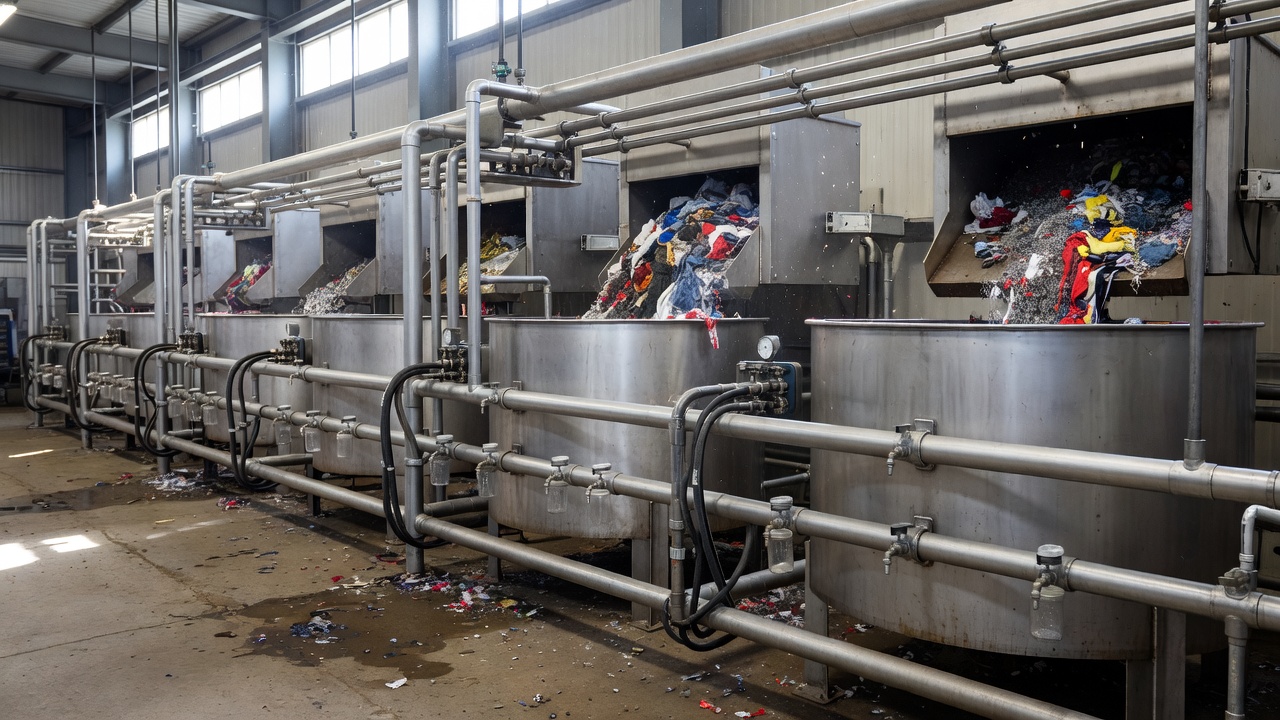
Prepare the feedstock for a chemical system
Hardware removal and size reduction still matter. So do dyes, coatings, soil, oils and unwanted polymers. Pretreatment may include washing, removal of specific contaminants or separation of fractions. These steps consume utilities and generate effluents or residues. They belong in the plant balance even when a simplified process diagram starts only at the reactor or dissolver.
Blends create distinct challenges. A cotton-polyester fabric may require selective treatment of one component while preserving, separating or managing the other. Elastane can interfere with purification or product quality, depending on the route. A multilayer coating may behave differently from a dispersed fibre blend. Published demonstrations should be read alongside their feedstock details: a controlled laboratory blend is not equivalent to an unsorted post-consumer bale.
Follow cellulose and polyester separately
Cellulose-rich textile waste can be prepared for regenerated-cellulose applications, but the recovered material must meet the requirements of the receiving process. Colour, residual contaminants and cellulose condition influence usability. A recovered pulp or solution is an intermediate, not finished fibre. Additional dissolution, spinning, washing and finishing stages may be required before a textile manufacturer has a qualified product.
For PET, depolymerisation routes can include glycolysis, methanolysis or hydrolysis, each producing different intermediate streams and requiring different reaction and purification conditions. The precise route affects chemical consumption, energy demand and impurity management. A recovered intermediate must meet a suitable specification before repolymerisation and subsequent fibre production. “Molecularly recycled” does not remove the need to test the material or explain the chain of custody.
Enzymatic approaches are another area of development. They also require preparation, controlled conditions and downstream separation. Evidence at laboratory or demonstration scale should not be described as continuous commercial performance. Distinguish announced capacity, installed capacity, commissioning activity and verified saleable output. These are different milestones, and a project can reach one without reliably achieving the next.
Make chemical recovery visible
Solvent recovery can reduce fresh solvent demand, but “closed loop” needs a stated boundary and measured losses. Ask how the recovery figure is calculated, what leaves in product or residues, and how purge streams are handled. Solvent make-up, degradation products, energy for recovery and wastewater treatment all affect the operating picture. A high recovery claim on one solvent stream does not describe the whole facility.
REACH and guidance from the European Chemicals Agency provide important context for chemicals management in Europe. Waste status, recovered-substance obligations and product requirements need case-specific assessment. The ZDHC Foundation’s wastewater guidance can be a useful textile-sector reference, but it is not a substitute for a plant’s discharge permit. Regulatory compliance and voluntary supply-chain requirements should be recorded separately.
| Route | Principal question | Output evidence |
|---|---|---|
| Selective dissolution | Which polymer dissolves, and what remains? | Polymer quality and contaminant results |
| Depolymerisation | Which molecules form, and how are they purified? | Intermediate purity and synthesis trials |
| Blend separation | Where does each component go? | Separate balances for recovered and rejected fractions |
Use real projects with careful boundaries
Worn Again Technologies, Circ and Infinited Fiber Company are relevant organisations to investigate when studying different textile recovery approaches. Their technologies and development histories should not be collapsed into a single category. Consult current company technical information, permitting records where available and independently supported operating evidence. A named technology is a starting point for due diligence, not an endorsement of current availability, commercial scale or environmental superiority.
The European Commission Joint Research Centre publishes work relevant to textile circularity and environmental assessment. Such analysis reinforces the need to compare equivalent products and realistic systems. An environmental comparison should account for input quality, allocation choices, electricity and heat supply, chemical production, treatment of residues and the manufacturing stages after recovery.
Technical note: ask for a component balance
Request a separate account of cellulose, polyester, other polymers, water and significant chemicals where feasible. An overall mass balance may look complete while concealing that a valuable component was destroyed, discharged or diverted into a low-value residue.
Reference points
- European Chemicals Agency — chemicals and recovered-substance guidance.
- ZDHC Foundation — textile-sector chemical and wastewater resources.
- Worn Again Technologies, Circ and Infinited Fiber Company — distinct technology reference points.
- European Commission Joint Research Centre — research and assessment resources.